

Colin Rhinesmith, University of Illinois Urbana-Champaign

Wednesday, February 18th, 2026 at 11 AM ET
Via Zoom – Registration: https://tinyurl.com/47ukftct
Digital Equity Ecosystems introduces readers to the groundswell of community coalitions that work to alleviate technological inequity and social injustice. Through a comprehensive review of theories and concepts across the fields of information, communication, technology, and public health studies, Colin Rhinesmith reveals how the digital equity ecosystems framework is essential for addressing urgent digital inequalities. Investigating five original case studies of digital equity ecosystems across the United States, Rhinesmith shows how community coalitions serve as vital infrastructure to tackle digital inequality and strengthen democracy. By focusing on these ecosystems as sites for community engagement, civic participation, and social justice organizing, this book helps us make sense of the current moment, arguing that it is crucial to bridge both the digital divide and other social divides more broadly at a time when democracies are in decline worldwide.
For full event information check out our events page.
 Angela Xiao Wu, New York University
Friday, January 30, 2026 at 11 AM ET
Via Zoom – Registration: https://tinyurl.com/2fv9xjka
Dr Wu will introduce she book-length research tracing the evolution of China’s administration of the socialist press into its regulation of private digital platforms. Reframing media history as utility history, she disaggregates the Chinese state into its lesser-studied roles—as lawmaker, owner, investor, licensor, thinly stretched administrator, and purported guarantor of collective welfare—beyond propaganda and censorship. This perspective sheds new light on post-reform Chinese governance and offers the utility system as a broader framework for thinking about our digital present: What happens to public culture when it is governed through unified computing regimes?
For full event information check out our events page.
New Paper: Disrupting echo chambers? How social media is related to social tolerance through network diversity: linked lives over a major life course event
MSUToday has published a helpful summary of new research findings from earlier this year with Keith Hampton and Kelley Cotter. The study confirms a key finding: young people from rural areas who attend university develop more racially and ethnically diverse social contacts. This increased diversity is directly related to them becoming more socially tolerant (i.e., more accepting of different people). Historically, this change did little to increase social tolerance within rural areas, as students typically reduced contact with their home communities and often chose not to move back after graduation. However, social media may be altering this dynamic. The research explores two competing hypotheses regarding how students maintaining their home ties via social media could affect their networks and tolerance:
1) Maintaining ties back home through social media appears to constrain the diversity of the students’ networks, thereby limiting social tolerance.
2) Conversely, it appears to expand the networks of the rural contacts they maintain online (we studied parents), which could ultimately reduce intolerance that tends to be more prevalent in rural communities.
The paper can be downloaded or read here: https://www.tandfonline.com/doi/full/10.1080/1369118X.2025.2460556
The MSU Today Post can be found here: https://msutoday.msu.edu/news/2025/12/how-social-media-shapes-tolerance-echo-chambers

The online talk was co-sponsored with the Pew Broadband Access Initiative
Laasya Koduru, UC Santa Barbra
Thursday, December 11, 2025,
Via Zoom | Check back for the recording
Effective broadband policy depends on accurate, granular data on service availability, speeds, and prices—yet existing datasets are often self-reported, inconsistent, and insufficient for evaluating affordability or targeting public investments. This talk will introduce the Broadband-Plan Querying Tool (BQT), which independently collects advertised broadband plans directly from ISP websites at street-address resolution to provide a more reliable evidence base. It will show how BQT enabled audits of the FCC’s Connect America Fund (CAF), revealing significant gaps in serviceability and compliance, and how the enhanced code-free BQT+ now supports over 50 ISPs to power statewide assessments such as the Pew and JCOTS studies on affordability, competition, and BEAD readiness. The talk will conclude with a roadmap for BQT+ as a sustainable data resource—supporting challenge processes, monitoring affordability over time, and equipping states with the independent data needed to design effective, equitable broadband interventions.
The broadband plan querying tool (BQT) automates interaction with an ISP’s web interface to obtain the set of Internet access plans (prices and speeds) available at a street-level residential address. BQT captures the Broadband nutrition label, which includes data for all available plans such as the maximum upload speeds, download speeds, and corresponding prices in US dollars. It also captures any ISP discounts advertised to users. In its current version (BQT+), BQT+ offers improved robustness and scalability over its predecessor. New ISPs can be more easily and quickly added, and modifications to existing ISP web interfaces are more easily accommodated. BQT+ can handle drop-down address selection and other features commonly incorporated into web pages that require user interaction. BQT and BQT+ have been applied to a variety of projects, including in partnership with multiple government and non-profit entities.
For full event information check out our events page.
Watch the recording: HERE
More information: https://quello.msu.edu/event/the-digital-usage-divide-evidence-and-new-measures-from-40-million-windows-devices/
 The talk was based on a recent NBER working paper by Mayana Pereira, Shane Greenstein, Raffaella Sadun, Prasanna Tambe, Lucia Ronchi Darre, Tammy Glazer, Allen Kim, Rahul Dodhia, & Juan Lavista Ferres (several of the co-authors are affiliated with Microsoft Research, the paper is available here: https://www.nber.org/papers/w32932). Starting from the fact that access to digital infrastructure is crucial for economic opportunities, social inclusion, and civic participation the paper analyzes new dimensions of how the use of digital technologies is unevenly distributed, leaving some communities unable to fully benefit from new technologies. Current measurements often rely on basic indicators, such as computer ownership and broadband adoption, which do not adequately capture the depth and variety of digital usage. We build and analyze new measures of digital usage that leverage telemetry data collected by Microsoft during operating system updates across 40 million Windows devices in U.S. households. These measures of U.S. household digital usage are significantly more comprehensive than those provided by any existing commercial or government survey. We construct representations of devices in ZIP codes and find evidence of significant variation in usage reflecting an urban-rural divide. We also show the existence of substantial disparities in usage even within narrowly defined Metropolitan Statistical Areas. Income and education correlate with these observed differences. These effects are large and suggest digital usage gaps that extend beyond the availability of essential IT infrastructure at the local level. These findings call for interventions beyond the traditional focus on infrastructure access and address usage and skills development. The indices are made publicly available to support future research.
For full event information check out our events page.
 Quello Center researchers had a strong presence at the 53rd Research Conference on Communications, Information and Internet Policy in Washington, D.C., September 19-20, 2025 (TPRC53). Elizabeth Mack, Johannes M. Bauer, Megan Knittel, Information and Media doctoral students Angie Nam and Boram Lee, and economics/data science undergraduate student Dhimaan Bhattacharya presented their paper The State of Bead: Assessing Progress Toward Universal Broadband Connectivity, available at SSRN: https://ssrn.com/abstract=5376286. Johannes M. Bauer chaired a paper session on Speed Tests and Broadband Literacy. He also co-organized a panel discussion on Governing Generative AI, featuring Erik Bohlin (Chalmers University), Nicol Turner Lee (Brookings Institution), and Madelyn Sanfilippo (University of Illinois Urbana-Champaign).
 This talk explores the imperative to measure digital trust as both a public good and a strategic asset. Drawing on conceptual insights from the World Economic Forum and recent academic work, Dr Chew introduces a multi-dimensional framework that accounts for the interplay between system attributes, individual dispositions, and lived outcomes in shaping digital trust.
For full event information check out our events page.
NEW/UPDATED: Quello Center releases a data collection checklist and a revised and updated version of the IIJA Assessment Framework
In response to the BEAD Restructuring Policy Notice of June 6, 2025, the Quello Center released a revised and updated version of its framework for the assessment of the effects of the Infrastructure, Investment, and Jobs Act of 2021 on high-speed Internet access, digital equity, and community development. Bauer, J.M., Mack, E., Nam, A., Lee, Boram, & Knittel, M. Assessing the Effects of the Infrastructure Investment and Jobs Act on High-Speed Internet Access, Digital Equity, and Community Development. Revised and Updated, East Lansing, Michigan: Quello Center at Michigan State University, July 7, 2025.
The Center also put together a checklist for State Broadband Offices (SBOs) on the minimum data needed for the effective monitoring and evaluation of the BEAD infrastructure deployment program. Quello Center. Data Requirements for the Effective Evaluation of the Restructured BEAD Program. A Guide and Checklist for Practitioners. East Lansing, Michigan: Quello Center at Michigan State University, July 7, 2025.
New Paper: Rethinking screen time and academic achievement: gender differences and the hidden benefit of online leisure through digital skills
The paper can be downloaded or read here: https://doi.org/10.1080/1369118X.2025.2516542
Talk: (Re)Working AI: Designing Workplace Technologies with and for Labor

Sarah Fox, Carnegie Mellon University
Abstract: Work is transforming rapidly. While some might suggest labor is in a perpetual state of change, the accelerated development and deployment of artificially intelligent (AI) systems within workplaces is set to reshape the livelihoods of millions of workers across industries for decades to come. Though proponents see potential in automation as a means to rid work of monotony and boost productivity, many workers and worker advocates view AI as an existential threat to “good jobs” or those that provide meaningful employment, adequate pay, and necessary health benefits. This disconnect is rooted in a fundamental distance between those whose interests are prioritized in the development process and those who end up using the technology. Although the fields of computer-supported cooperative work (CSCW) and human-computer interaction (HCI) have a legacy of exploring methods of promoting worker participation in the design of particular workplace systems, less is understood about how participatory research approaches could be applied across the technology lifecycle to increase value for those on the frontlines. In this talk, Fox will outline the concept of “worker-centered design,” an approach that emphasizes the well-being and input of employees, aiming to enhance not only productivity but also cooperation, autonomy, and fulfillment. Drawing on ongoing ethnographic and design research, she will discuss two distinct cases in sectors facing different forms of technological change: 1) public transportation, for which autonomous vehicle technologies are being developed; and 2) hospitality, which regularly employs algorithmic management. Across these sites, Fox describes labor-aligned efforts to evaluate the impacts of AI technologies on work practices and to develop methods and tools to ensure that working people have a voice in the creation, integration, and governance of technologies in their workplaces.
More information HERE

Robert Gorwa, WZB Berlin Social Science Center

Michael Veale, University College London
April 14, 2025 at 12 PM EDT, we hosted a talk on Full Stack AI Governance with Robert Gorwa, WZB Berlin Social Science Center and Michael Veale, University College London.
Every time someone trains, deploys, or queries an ‘artificial intelligence’ system, whether they know it or not, they are implicating the practices and services of an enormous number of interlinked businesses in the AI ‘stack’. In this talk, Robert Gorwa and Michael Veale will present early findings from their ongoing book project on emerging public-private regulatory practices emerging across this stack, focusing on what does, could, and should be done to prevent very real emergent forms of AI misuse. As more obligations and responsibilities are foisted on or taken up by the various intermediaries that facilitate access to AI systems (e.g. cloud providers, model hosts, internet infrastructure providers), the talk will introduce some of the extremely tricky tensions relating to technological control, generativity, analytic capacity, and privacy that lay ahead.
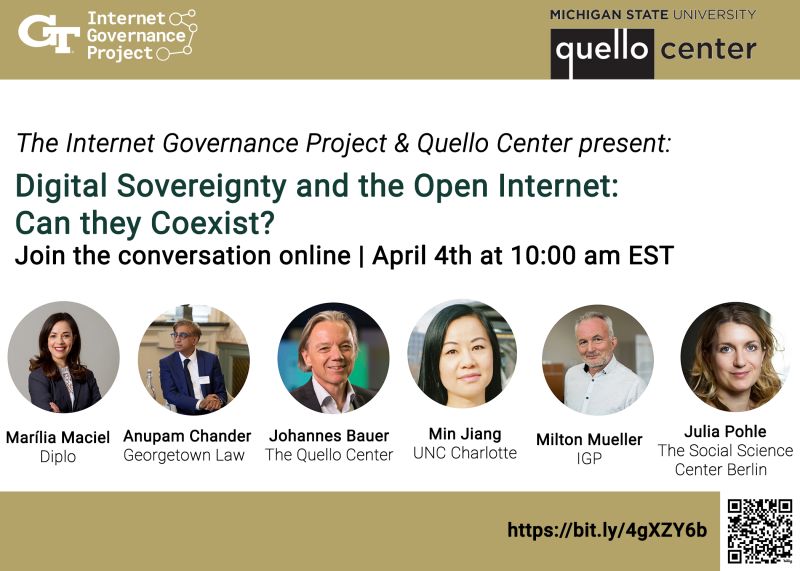
On April 4, 2025, the Internet Governance Project (IGP) in collaboration with the Quello Center gathered scholars of differing views to debate what digital sovereignty means, how it is being used as a label, and whether the various interpretations of the term are compatible with the foundational values of the open internet.
The five panelists engaged in a spirited and controversial debate. If you missed it, please check out the video at: https://youtu.be/e-y1Iz7eXVE?si=JuiLVwySnlFuBdz5.
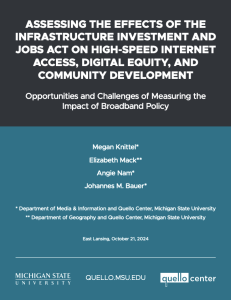
Supported by a grant from The Pew Charitable Trusts Broadband Access Initiative, this report develops a framework for the assessment of the effects of the Infrastructure, Investment, and Jobs Act of 2021 on high-speed Internet access, digital equity, and community development. With the funding authorized by the Infrastructure Investment and Jobs Act 2021 (Infrastructure Act), the federal government, states, and communities will have a window of opportunity to close digital connectivity gaps improve digital equity, and to transform communities. The scale and diversity of current federal, state, and local policy initiatives creates a needs transparency and accountability to assure the responsible use of public funds.
Even though the Infrastructure Act and NTIA implementation guidelines supply an integrative framework, states and territories have developed varying models to meet their specific needs. Given the many challenges of such a large-scale effort, it is to be expected that some will be more effective than others. If properly monitored and evaluated, these variations can be translated into knowledge that can help improve all programs for the remaining duration of the program. The first report from the project, released today, develops principles to ease the burden on eligible entities of meeting their statutory reporting requirements and to guide data collection, program monitoring, and impact evaluation going forward.
For more information see quello.msu.edu/iija-assessment

From Left to Right- Johannes Bauer, MSU Professor
Charlotte Bewersdorff, VP Community Engagement, Merit Network
Roger Blake, CEO, Merit Network
Kevin Guskiewicz, MSU President
Keith Hampton, Director of Academic Research, Quello Center
𝗗𝗮𝘁𝗲: Tuesday, September 10, 2024
After two years, Project MOON-Light, a network-wide, significant upgrade of Michigan’s middle mile Internet infrastructure, was completed. MOON-Light is a collaboration between Michigan State University, Merit Network, and the Quello Center. It was supported in part by a grant from the National Telecommunications and Information Administration’s Broadband Infrastructure Program. The enhanced middle mile capabilities will enable local internet service providers to connect residents and businesses in unserved areas of the state and improve the quality of service to areas that are currently served by lower access speed and quality of service. Representatives from the Quello Center, Michigan State University, Merit Network, NTIA, Merit Network member organizations, and internet service providers, celebrated the completion of the project with an event at Michigan State University.
The recording of our live-streamed the event can be watched here: https://hubs.la/Q02PcqlQ0
New Quello Center Study: Broadband and Student Performance Gaps After the COVID-19 Pandemic
It builds on the findings of a study on Broadband and Student Performance Gaps released in the weeks before the start of the COVID-19 pandemic (Hampton et al., 2020). That report highlighted the low levels of broadband access by rural Michigan students and the detrimental impact from a lack of access on their academic performance, educational aspirations, career choices, and general well-being. In 2022, we returned to the same schools that we first surveyed in 2019. We asked students about their experience with Internet technologies and with learning from home during the pandemic. Our findings paint a picture of how rural school districts and other stakeholders rapidly mobilized to address a national crisis. In a remarkably short period of time, schools accessed state and federal resources to close gaps in rural Internet access and computing devices.
Digital Opportunities Compass: Metrics to Monitor, Evaluate, and Guide Broadband and Digital Equity Policy
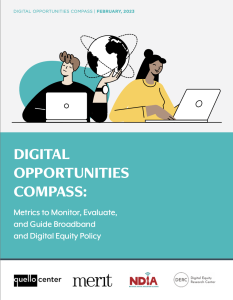 East Lansing, MI – February 24, 2023. The Infrastructure Investment and Jobs Act of 2021 (IIJA) and the Digital Equity Act of 2021 (DEA) establish a broad framework and significant funding to advance broadband connectivity and digital equity. Both Acts recognize that closing the broadband access and device gaps are necessary first steps toward digital equity. To fully realize the full benefits of digital technology for individuals, communities, and society at large additional efforts are needed.
The Digital Opportunities Compass offers a framework to assist in the development of state plans that meet the reporting and assessment requirements of IIJA and DEA but go beyond access and affordability to fully harness the benefits of digital technology. As communities and states develop plans to improve digital equity, it is important to establish a shared framework to establish goals and priorities, to identify opportunities, and monitor progress toward these goals.
Major Federal Grant Awarded to MSU and Merit Network
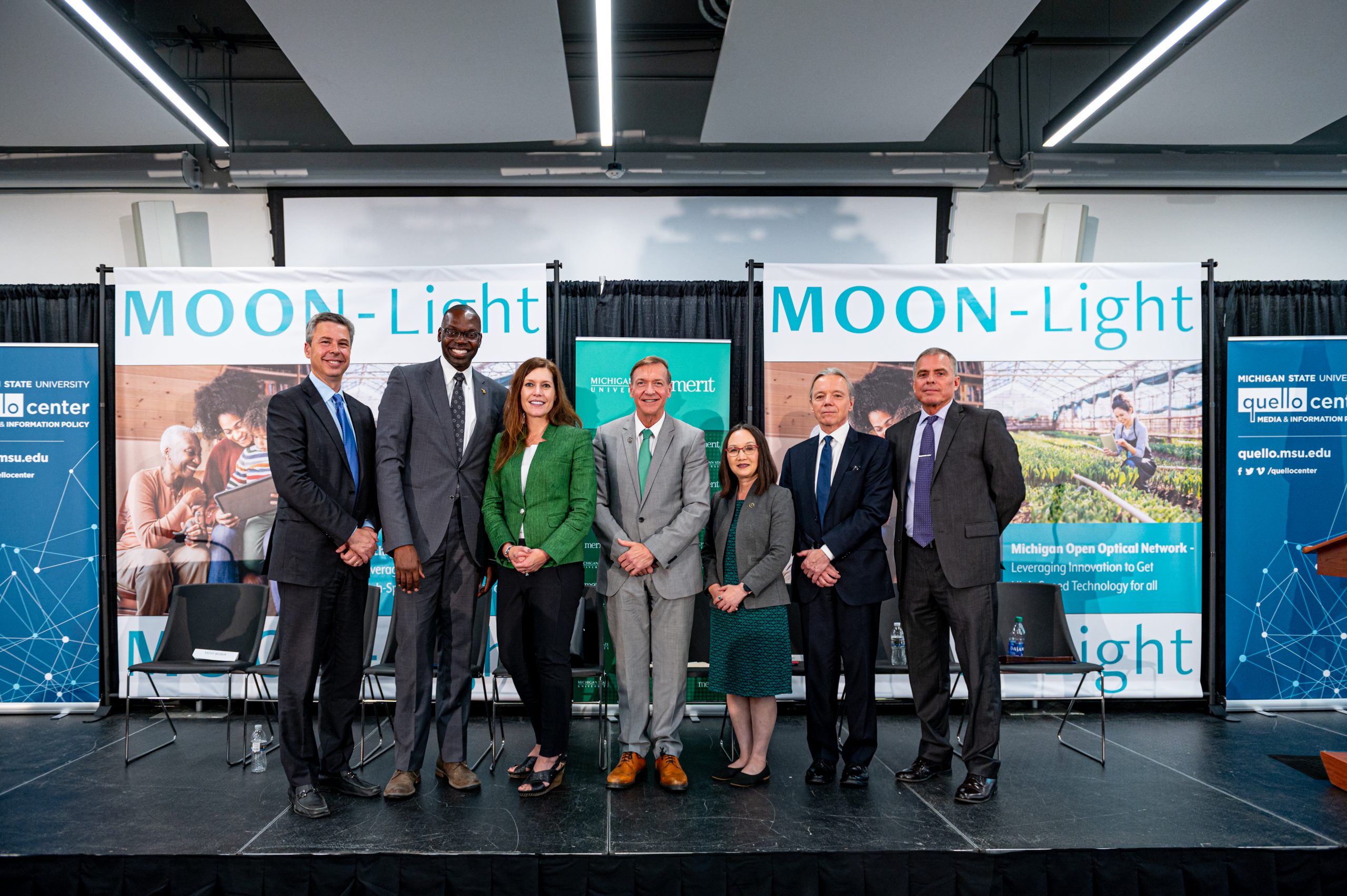
Announcing MSU and Merit Network as joint recipients of a $10.5 million National Telecommunications and Information Administration Broadband Infrastructure Program Grant to build out “middle mile” networking supporting high-speed internet/broadband to underserved areas of Michigan. From left: NTIA Special Representative for Broadband Andy Berke, Michigan Lieutenant Governor Garlin Gilchrist III, MSU Board of Trustees Member Renee Knake-Jefferson, MSU President Samuel L. Stanley, MSU Executive VP for Administration Melissa Woo, Quello Center Director Johannes M. Bauer, Merit President and CEO Joe Sawasky.
Full press release with more information.
Quello Center and Community Partners Recognized with 2022 MSU Distinguished Partnership Award
Featured Research Project:
The Role of Ethics in Information Policy
Research team: Johannes M. Bauer (Quello Center, MSU)
Recent working paper: Bauer, Johannes M., New Guardrails for the Information Society (September 12, 2021). Quello Center Working Paper No. 05-21, Available at SSRN and DOI.
Overcoming COVID-19 Vaccine Hesitancy: A United States-United Kingdom Comparison
 Achieving a high overall vaccination rate is crucial for overcoming the COVID-19 pandemic. To prevent widening inequalities, it is also important to increase vaccination rates among the diverse populations that are most gravely affected by the pandemic. Governmental, healthcare, and policy groups need data to guide their strategic vaccination campaigns. This policy brief presents insights from data collected shortly before vaccines were formally approved. Our analysis helps to understand the factors that influence the willingness to be vaccinated and informs strategies to reach vaccine hesitant populations.
Download Quello Center Policy Brief
Broadband and Student Performance Gaps: A Checklist for K12 Schools Considering Online Teaching in Response to COVID-19
 School districts face difficult choices. Large scale shifts in public education to an online curriculum must consider inequalities in broadband access, devices and skills, as well as parental and caretaker involvement. However, these inequalities cannot be overcome immediately. Unless schools decide against online teaching altogether because of these concerns (a strategy that has disadvantages for connected students), they need to find responses that minimize potential disadvantages for vulnerable populations. Key considerations are (1) offering of measures to improve the capacity of teachers, parents and learners to adapt to online learning, (2) appropriate design and use of distance learning, and (3) short-term measures to improve access to broadband. Quello Center Policy Brief 01-20 lays out options for short-term and long-term responses to the crisis.
Four Things A School District Needs to Know Before Moving Education Online
Download Quello Center Policy Brief 01-20 | Download Broadband and Performance Gap Report
By William H. Dutton, originally posted on Substack – https://williamhdutton.substack.com/ Not a day goes by when someone does not blame a probl
Johannes M. Bauer, June 27, 2025 Key points Background The BEAD Restructuring Policy Notice of June 6, 2025 (PN) greatly narrows the vision embedded i
Digital Equity Ecosystems: How Community Coalitions Reduce Inequality and Strengthen Democracy a talk with Colin Rhinesmith, University of Illinois Urbana-Champaign Join us on February 18, 2026, from 11:00 AM – 12:00 PM ET for a stimulating talk! Use the link here to register for the Zoom webinar: https://tinyurl.com/47ukftct Digital Equity Ecosystems introduces readers to the groundswell of community coalitions that work to alleviate technological inequity and social injustice. Through a comprehensive review of theories and concepts across the fields of information, communication, technology, and public health studies, Colin Rhinesmith reveals how the digital equity ecosystems framework is essential for addressing urgent […]
Misattribution, Confounds, and Meaninglessness in Social Media and Mental Health Research a talk with Keith Hampton, Quello Center at Michigan State University Join us in person or online on March 18, 2026, from 11:00 AM – 12:00 PM ET for a stimulating talk! See you in CAS 191 or use the link here to register for the Zoom webinar: https://tinyurl.com/47ukftct More information to come!
Translucent Atmospherics: Media as Utility in China a talk with Angela Xiao Wu, New York University Join us on January 30, 2026, from 11:00 AM – 12:00 PM ET for what is sure to be a fascinating exchange! Use the link here to register for the Zoom webinar: https://tinyurl.com/2fv9xjka Utilities provide essential services such as water, electricity, railroads, and communication, which societies strive to make affordable and widely accessible. As legacy media lose advertising revenue and “news deserts” proliferate, proposals to treat journalism as a public utility have reemerged. While liberal capitalist societies approach this idea through fragmented evidence and […]
Co-sponsored talk by the PEW Broadband Access Initiative & the Quello Center with Laasya Koduru, PhD Student at UC Santa Barbra Thursday, December 11, 2025, 2-3 PM EST Via Zoom | Please Register HERE Effective broadband policy depends on accurate, granular data on service availability, speeds, and prices—yet existing datasets are often self-reported, inconsistent, and insufficient for evaluating affordability or targeting public investments. This talk will introduce the Broadband-Plan Querying Tool (BQT), which independently collects advertised broadband plans directly from ISP websites at street-address resolution to provide a more reliable evidence base. It will show how BQT enabled audits of the FCC’s […]
A Brownbag Lunch with Dr Chris Adami, Microbiology and Molecular Genetics & Physics and Astronomy, Michigan State University. Wednesday October 22, 2025, 12-1 PM EDT In-Person CAS 405 and on Zoom Please Register HERE Light refreshments will be provided. Chris Adami has done innovative work in applying evolutionary methods and game theory to complex phenomena, social issues, cognitive issues, and artificial life. He often writes in non-technical ways for broader audiences, and his contributions regularly appear in Nature. The brownbag lunch talk explores the systemic nature of inequality in a highly abstract framework to isolate critical factors that drive inequality but […]