



New Quello Center Study: Broadband and Student Performance Gaps After the COVID-19 Pandemic
It builds on the findings of a study on Broadband and Student Performance Gaps released in the weeks before the start of the COVID-19 pandemic (Hampton et al., 2020). That report highlighted the low levels of broadband access by rural Michigan students and the detrimental impact from a lack of access on their academic performance, educational aspirations, career choices, and general well-being. In 2022, we returned to the same schools that we first surveyed in 2019. We asked students about their experience with Internet technologies and with learning from home during the pandemic. Our findings paint a picture of how rural school districts and other stakeholders rapidly mobilized to address a national crisis. In a remarkably short period of time, schools accessed state and federal resources to close gaps in rural Internet access and computing devices.
Digital Opportunities Compass: Metrics to Monitor, Evaluate, and Guide Broadband and Digital Equity Policy
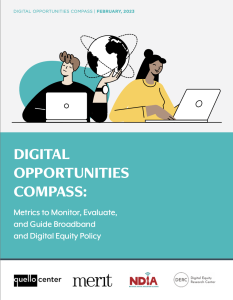 East Lansing, MI – February 24, 2023. The Infrastructure Investment and Jobs Act of 2021 (IIJA) and the Digital Equity Act of 2021 (DEA) establish a broad framework and significant funding to advance broadband connectivity and digital equity. Both Acts recognize that closing the broadband access and device gaps are necessary first steps toward digital equity. To fully realize the full benefits of digital technology for individuals, communities, and society at large additional efforts are needed.
The Digital Opportunities Compass offers a framework to assist in the development of state plans that meet the reporting and assessment requirements of IIJA and DEA but go beyond access and affordability to fully harness the benefits of digital technology. As communities and states develop plans to improve digital equity, it is important to establish a shared framework to establish goals and priorities, to identify opportunities, and monitor progress toward these goals.
Major Federal Grant Awarded to MSU and Merit Network
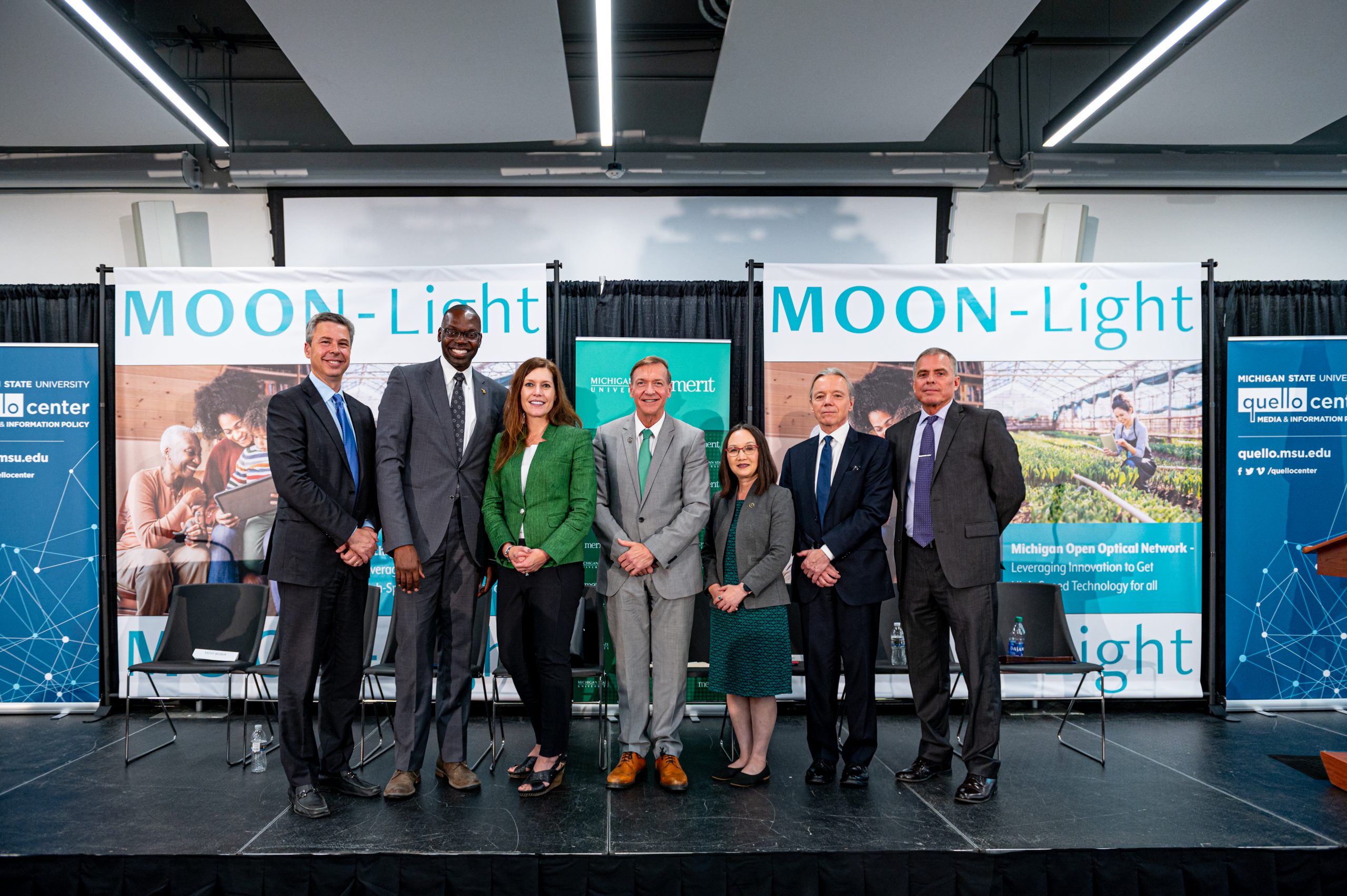
Announcing MSU and Merit Network as joint recipients of a $10.5 million National Telecommunications and Information Administration Broadband Infrastructure Program Grant to build out “middle mile” networking supporting high-speed internet/broadband to underserved areas of Michigan. From left: NTIA Special Representative for Broadband Andy Berke, Michigan Lieutenant Governor Garlin Gilchrist III, MSU Board of Trustees Member Renee Knake-Jefferson, MSU President Samuel L. Stanley, MSU Executive VP for Administration Melissa Woo, Quello Center Director Johannes M. Bauer, Merit President and CEO Joe Sawasky.
Full press release with more information.
Quello Center and Community Partners Recognized with 2022 MSU Distinguished Partnership Award
Featured Research Project:
The Role of Ethics in Information Policy
Research team: Johannes M. Bauer (Quello Center, MSU)
Recent working paper: Bauer, Johannes M., New Guardrails for the Information Society (September 12, 2021). Quello Center Working Paper No. 05-21, Available at SSRN and DOI.
Overcoming COVID-19 Vaccine Hesitancy: A United States-United Kingdom Comparison
 Achieving a high overall vaccination rate is crucial for overcoming the COVID-19 pandemic. To prevent widening inequalities, it is also important to increase vaccination rates among the diverse populations that are most gravely affected by the pandemic. Governmental, healthcare, and policy groups need data to guide their strategic vaccination campaigns. This policy brief presents insights from data collected shortly before vaccines were formally approved. Our analysis helps to understand the factors that influence the willingness to be vaccinated and informs strategies to reach vaccine hesitant populations.
Download Quello Center Policy Brief
Broadband and Student Performance Gaps: A Checklist for K12 Schools Considering Online Teaching in Response to COVID-19
 School districts face difficult choices. Large scale shifts in public education to an online curriculum must consider inequalities in broadband access, devices and skills, as well as parental and caretaker involvement. However, these inequalities cannot be overcome immediately. Unless schools decide against online teaching altogether because of these concerns (a strategy that has disadvantages for connected students), they need to find responses that minimize potential disadvantages for vulnerable populations. Key considerations are (1) offering of measures to improve the capacity of teachers, parents and learners to adapt to online learning, (2) appropriate design and use of distance learning, and (3) short-term measures to improve access to broadband. Quello Center Policy Brief 01-20 lays out options for short-term and long-term responses to the crisis.
Four Things A School District Needs to Know Before Moving Education Online
Download Quello Center Policy Brief 01-20 | Download Broadband and Performance Gap Report
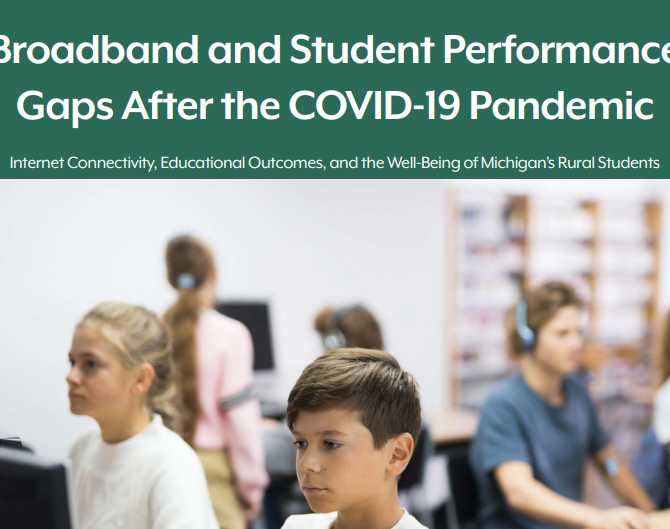
A new study from Michigan State University warns that gains made to address broadband and internet connectivity in Michigan rural communities are

Digital Opportunities Compass: Metrics to Monitor, Evaluate, and Guide Broadband and Digital Equity Policy Reposted from the Benton Institute for
Via Zoom RSVP Here | or email quello@msu.edu Persistent digital divides exist between Northern and Southern Canada, and among communities in Northern Canada. Along with large-scale commercial telecommunications projects, locally designed and deployed networks offer potential solutions to improve connectivity. Community Networks involve residents in the deployment, ownership, and control of digital infrastructures – though such efforts also face many challenges. In this presentation Dr. McMahon will introduce DigitalNWT, a participatory action research initiative focused on these issues. After an overview of DigitalNWT’s research, education and policy engagement activities, he will discuss the process that was used to codesign community networking resources with […]
Via Zoom RSVP Here | or email quello@msu.edu Early in 2020, the use of telehealth for primary care exploded because of the COVID-19 pandemic. Funded by PCORI, their team launched an extensive set of quantitative and qualitative evaluations of this natural experiment and its impact on healthcare. Ancker will report on their findings about patient and provider experiences in three states on the basis of interviews and surveys, as well as a Medicare claims-based analysis of the effects of telehealth on preventable healthcare utilization. Jessica S. Ancker, MPH, PhD, is a professor of biomedical informatics and health policy at Vanderbilt University Medical Center. […]
In Person in CAS Room 191 and Via Zoom RSVP Here | or email quello@msu.edu A Rural Computing Research Consortium/Quello Center joint event. Responsible innovation can be helpful in the realm of developing climate-smart farming tools, where data-driven technologies, AI modeling, and localized farm data can enable climate adaptation and mitigation. However, to achieve benefits of these innovations for the public interest and for scaling up, it is imperative to cultivate trust among a range of actors and organizations across the food system value chain. This trust-building process necessitates the development of transparent pathways for converting raw data into actionable insights, a task that […]